Blog
Is Backlit Onyx Worth It? Design Ideas for OC Homes
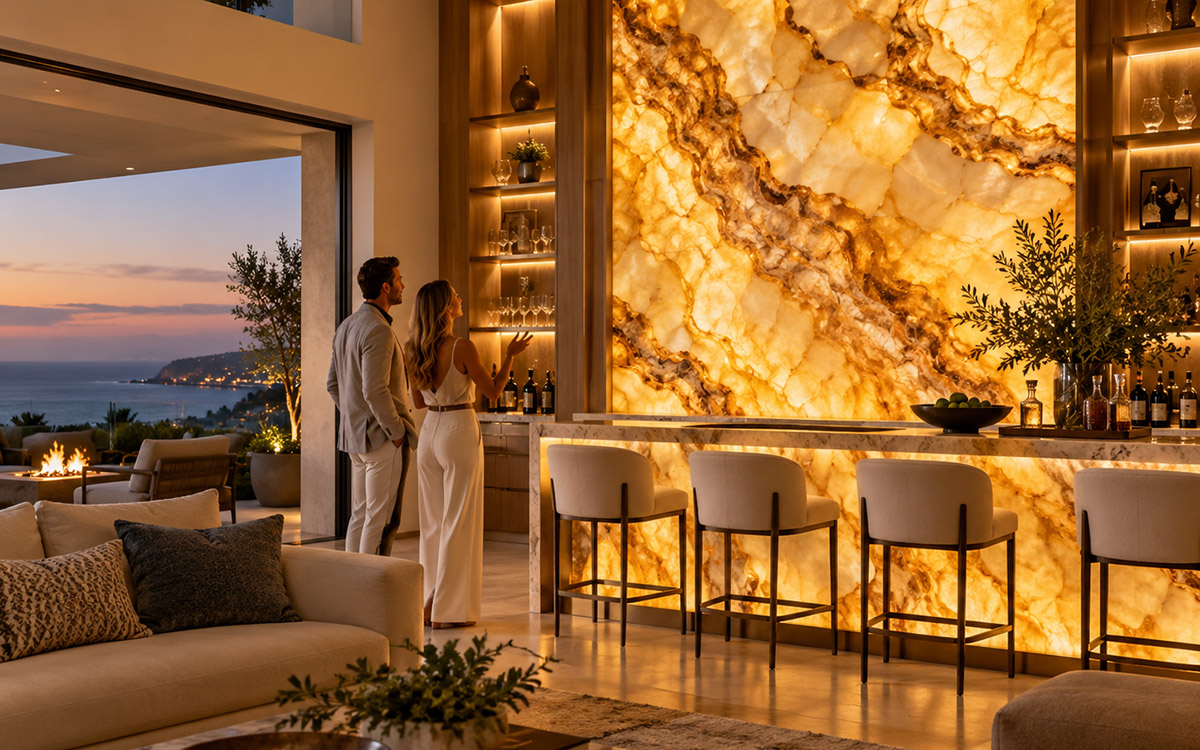
Where backlit onyx makes the biggest impact in Orange County homes, plus the lighting, backing, and care details designers should plan for early.
A designer is standing in a client’s spacious room, looking at a blank wall beside the home bar. The client wants a single piece that guests will talk about for years. Among all the natural stone slabs Orange County designers can choose from, backlit onyx is often the answer. It glows like amber held up to the sun. So is it worth it? Yes, when you plan it as a lighting fixture from the start, not as an afterthought. At Trendy Surfaces, we see this scenario play out often at our Irvine slab yard and Laguna Niguel design center. Here is what makes the difference.
Key Takeaways
- Backlit onyx works best on vertical or low-wear surfaces like feature walls, bar fronts, and vanity walls, where its glow matters more than its toughness.
- Most onyx sold for interiors is calcite-based, so it is softer than granite and will etch on contact with acids like citrus, wine, and vinegar.
- Thin onyx is usually laminated to glass (or reinforced with resin and mesh) so it can be backlit safely and let more light through.
- Lighting suppliers recommend even LED light sheets set about 35 to 40 mm behind onyx, and warm 2700K to 3000K light brings out amber and honey veining.
- Viewing the actual slab against a light before you commit is the only reliable way to judge how a specific piece will glow.
Is Backlit Onyx Worth It Among Natural Stone Slabs for Orange County Homes?
Backlit onyx is worth it for high-visibility, low-wear features such as accent walls, bar fronts, and powder rooms. It is a weaker fit for busy kitchen prep counters. Think of it as part lighting fixture, part stone: the payoff comes from careful placement and lighting planned in from day one.
What makes onyx glow (and other stones don’t)?
Onyx forms in layers, which provides it those soft bands of honey, cream, green, and white. Many of these layers are thin and translucent, so light passes through them. Most dense stones, like granite, simply block light. When you browse onyx slabs, you are really looking at two designs in one: how the stone looks in daylight and how it looks when lit from behind.
When it’s not the right call
Onyx is one of the most acid-sensitive stones you can buy. Stone care guides like this one on etch-prone stones rate it at very high risk and suggest keeping it to low-use areas. Skip it for heavy prep counters, spaces where cleaning with acidic products is routine, or budgets with no room for lighting and fabrication.
Where Backlit Onyx Shines: 5 Design Ideas
The best placements put onyx where people look, not where they chop, spill, or lean. These five ideas show up again and again in Orange County homes.
Feature walls and entry statements
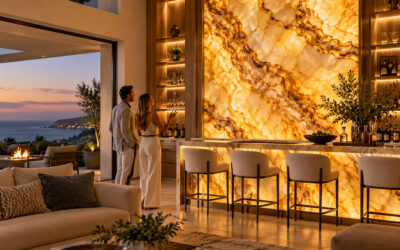
A lit onyx wall in a living room, stairwell, or entry greets guests with warm, even light. Many designers use book-matching here, which means cutting two neighboring slices from the same block and opening them like the pages of a book so the veining mirrors itself. For more inspiration, see our feature wall cladding ideas.
Home bars and bar fronts
OC homeowners love to entertain, and a glowing bar is hard to beat. The smart move is to light the bar die (the front panel facing guests) and use a tougher stone on top.
Vanity walls and powder rooms
A glowing wall behind the mirror turns a small powder room into a jewel box. Powder rooms see little daily wear, which makes them ideal for a soft stone. The light also flatters faces, which guests notice.
Kitchen island waterfall or end panels
You can bring onyx into the kitchen without putting it under knives and lemons. Light the vertical sides of the island and keep the work surface practical. Our guide to the best natural stone for kitchen islands covers durable top options that pair well.
Fireplace surrounds
Onyx can make a striking decorative surround. Heat is the concern here, so confirm safe clearances with your fireplace manufacturer and fabricator before you design around it. Keep the onyx as trim, not as part of the firebox.
Treat backlit onyx as a lighting fixture first and a countertop second.
Lighting Backlit Onyx: LED Panels, Spacing, and Heat
Lighting suppliers recommend thin, even LED light sheets set roughly 35 to 40 mm behind onyx, in warm white, running at low voltage. This setup spreads light smoothly, avoids bright spots, and stays cool. Always mock up the actual slab with the chosen light before final install.
LED sheets vs. strips
Translucency changes across a single slab. As lighting maker EOS Light explains, single points of light can shine through thin spots as bright dots, while thick veins stay dark. LED sheets spread light across the whole panel, so the glow looks even.
Gap and diffusion
How far the light sits behind the stone matters. LED supplier SignLite recommends a 35 to 40 mm gap for Onyx to avoid hot spots and notes that Onyx used for backlighting is often 6 to 12 mm thick. Treat these as supplier recommendations, then test with your slab, since every piece behaves a little differently.
Color temperature
Color temperature describes how warm or cool white light looks, measured in Kelvin (K). Lighting suppliers suggest 2700K to 3000K to deepen gold and amber tones, while cooler light tends to flatten the veining. Tunable or color-changing LEDs are an option if you want to shift the mood.
Heat and service access
Modern LEDs run much cooler than the fluorescent light boxes once common behind stone. Dedalo Stone cites an LED life of roughly 30,000 to 50,000 hours, but parts still fail eventually. Plan an access panel for drivers and light sheets, since stone is difficult to remove once installed.
Support and Backing for Backlit Natural Stone Slabs in Orange County
Onyx usually needs a clear backing, either laminated glass or resin with mesh. Backing keeps the stone strong when it is cut thin, and thin stone lets more light through. Ask your fabricator which backing suits your slab, panel size, and location before ordering natural stone slabs Orange County shops will fabricate.
Glass lamination
In glass lamination, a thin layer of stone is bonded to glass under pressure using a clear film. Dedalo Stone describes panels starting at around 8 mm total, with thicker builds for larger pieces. Tempered or laminated safety glass is the usual choice, especially in high-traffic spots.
Resin and mesh reinforcement
Onyx often has natural fissures (small cracks). Many slabs arrive with resin and a fiberglass mesh on the back to hold them together. Ask whether that backing is clear, since an opaque mesh can cast a grid of shadows once lit.
Framing and anchors
Clips and anchors behind the stone can show up as dark halos when the lights come on. Hidden mounting systems avoid these issues. Bring your contractor, electrician, and fabricator together early so the framing, wiring, and stone all line up.
Softness, Etching, and Everyday Care
Calcite onyx is soft and reacts strongly to acid. Sealing helps resist stains, but it does not stop etching, which is a dull mark left when acid eats into the surface. Use pH-neutral cleaners, blot spills right away, and keep acidic drinks on coasters.
Calcite onyx vs. true silica onyx
Geologists use “onyx” for a dense, silica-based banded stone. As Stone Specialist notes, most slabs sold as onyx are actually calcite, sometimes called onyx marble, and they are softer and vulnerable to acid. Fabricators sometimes confirm this information with a drop of mild acid (a fizz test), but that is a trade check, not a homeowner task. They also suggest white setting materials so darker adhesives do not show through.
Care routine
The Natural Stone Institute, as cited in TileLetter’s stone care guide, groups onyx with marble and limestone as acid-sensitive stones. Use a neutral cleaner, test any product in a hidden spot first, and avoid vinegar and citrus. If onyx tile is part of the job, seal it before grouting.
Polished vs. honed under backlight
A polished finish is glossy and reflects more room light. A honed finish is smooth but matte, and it gives a softer, warmer glow when lit. Honed faces can also hide small etch marks a bit better.
Sealing protects onyx from stains, but only good habits protect it from etching.
Beyond Onyx: Semi-Precious and Other Glowing Options
If Onyx feels too quiet, there are bolder ways to work with light. Pairing also matters, since the glowing piece needs calm neighbors.
Semi-precious slabs
Agate and similar gemstones can be sliced and set in resin to create dramatic, translucent panels. Our semi-precious slabs make striking bar fronts and accent walls. They read more like art than stone.
Pairing with marble and porcelain
Let Onyx be the star. Use durable marble or porcelain on nearby work surfaces and floors, in quieter tones that echo the onyx. Trendy Surfaces can help you build a palette that ties the room together.
Planning Your Natural Stone Slabs Orange County Project
Good backlit projects start with the right slab and a clear plan. Here is how to get both.
Choose the slab in person
Photos rarely show how onyx glows. Bring room photos and dimensions, and ask to see the slab lit from behind. Our post on what to bring to a slab yard appointment has a handy checklist.
Budget factors
Your total includes more than the slab: lamination or backing, LED sheets, electrical work, framing, and access panels all add up. Material availability, pricing, and lead times vary by project and are confirmed in the showroom or by quote. The Trendy Surfaces team can walk you through each piece.
Conclusion: Plan the Glow From Day One
Backlit onyx is worth it when two things line up. First, the placement suits a soft, acid-sensitive stone, like a feature wall, bar front, or powder room. Second, the lighting, backing, and access are designed in from the start, not added later. Get those right, and Onyx becomes the piece people remember.
Ready to see backlit onyx in person? The team at Trendy Surfaces has been helping Orange County homeowners, designers, and contractors find the right tile, stone, and flooring for their projects, including onyx slabs you can view as full pieces.
Visit the Irvine Slabyard & Showroom at 17912 Cowan, Unit C, Irvine, CA 92614, or call (714) 284-0118. Or stop by the Laguna Niguel Design Center at 23811 Aliso Creek Road, Ste 176, Laguna Niguel, CA 92677, or call (949) 446-8121.
Frequently Asked Questions
Is backlit onyx durable enough for a kitchen countertop?
Onyx is soft and etches easily when it meets acids like lemon juice, wine, or vinegar. That makes it a poor fit for busy prep counters. It works better on low-wear surfaces like island end panels, bar fronts, and feature walls, with a tougher stone on the work surface.
How far should LED panels be from backlit onyx?
Lighting suppliers recommend a gap of about 35 to 40 mm between LED light sheets and onyx to avoid bright hot spots. This is a supplier recommendation rather than a fixed rule. Because translucency varies across every slab, test the actual stone with the chosen lights before final installation.
Does backlit onyx get hot?
Modern LED light sheets run much cooler than the fluorescent boxes once used behind stone, so the surface typically stays comfortable. Your lighting designer and electrician should still plan for proper ventilation and an access panel for drivers. For fireplace surrounds, confirm heat clearances with the fireplace manufacturer and fabricator.
How do you clean and protect an onyx vanity or bar top?
Use a pH-neutral stone cleaner and blot spills right away. Avoid vinegar, citrus, and harsh cleaners, and test any new product in a hidden spot first. Sealing helps resist stains but does not prevent etching, so coasters and quick cleanup matter most.
Can you see backlit onyx slabs in person in Orange County?
Yes. Trendy Surfaces carries onyx slabs at its Irvine Slabyard & Showroom, where you can view full slabs, and its Laguna Niguel Design Center offers design help. Bring photos and dimensions, and ask to see a slab lit from behind so you can judge its glow.