Blog
Dolomite vs. Marble: Which Stone Slab Fits Your Kitchen?

Two white stones that look almost identical, compared on hardness, etching, and daily upkeep, so you can choose the right kitchen countertop.
You are standing between two white slabs with soft gray veins, and you honestly cannot tell them apart. One is marble, one is dolomite, and the care advice for each sounds a little different. This scenario is one of the most common moments for anyone shopping for countertop slabs Orange County showrooms carry. At Trendy Surfaces, we see it every week. This guide gives you a straightforward comparison of hardness, etching, sealing, and everyday upkeep, so you know what living with each stone is really like. When you are ready, you can see both side by side at our Irvine slab yard or our Laguna Niguel design center.
Key Takeaways
- Dolomite and marble are both carbonate stones, but dolostone contains magnesium, which makes it slightly harder and a little slower to react to acids.
- Dolomite rates about 3.5 to 4 on the Mohs hardness scale, compared with about 3 for calcite marble, so it resists everyday scratches a bit better.
- Both stones can etch from lemon, wine, vinegar, and tomato, and sealing helps prevent stains but does not stop etching.
- A honed finish hides etch marks better than a polished finish on either stone.
- Seeing full slabs in person is the best way to judge veining, finish, and how a stone will look in your kitchen.
What Is the Difference Between Dolomite and Marble?
Marble is a metamorphic rock made mostly of calcite, which is calcium carbonate. Dolomite is made of calcium magnesium carbonate. That added magnesium is the key difference. It makes dolomite a little harder and a little slower to react with acids, even though the two stones can look nearly identical on a showroom floor.
How marble forms
Marble starts life as limestone. Over time, heat and pressure deep in the earth fuse its calcite grains into a dense, crystalline stone. According to the geology of classic marble, natural impurities shape its look: iron oxide brings pink and gold tones, graphite adds gray, and folded clay layers create those flowing swirls.
What makes dolomite different
A “carbonate stone” simply means a stone built from carbonate minerals, the same family as chalk and seashells. Dolomite has magnesium alongside calcium in its crystals. The mineral profile of dolomite describes it as calcium magnesium carbonate that dissolves only slowly in cold, dilute acid. If you want to browse examples, our dolomite slabs show how bright and varied this stone can be.
Why slab names can be confusing
Stone trade names are not standardized. The same name can be used for slabs from different quarries, and composition can shift from one quarry lot to the next, as this guide to telling dolomite and marble apart points out. The simplest fix is to ask your supplier what a slab actually is before you commit.
Hardness and Scratch Resistance: How the Two Stones Compare
Dolomite rates about 3.5 to 4 on the Mohs scale, while calcite marble sits around 3. Both are softer than granite, so neither is scratch-proof. Still, that half point or more makes dolomite the somewhat tougher choice for a busy kitchen where pots, plates, and utensils move across the counter all day.
What the Mohs scale means at home
The Mohs scale ranks minerals from 1 (softest) to 10 (hardest) by which ones can scratch others. At a rating near 3, marble can be scratched by knives, ceramic dishes, and cast iron pans. Dolomite holds up a bit better, though a cutting board is still a smart habit with either stone.
Chips, edges, and impacts
A heavy object dropped on marble can leave a stain mark, a small cloudy white spot where the crystals were bruised. The Marble Institute’s geology overview notes these are cosmetic, while a significant knock on an edge can chip it. Edges are the most exposed spot on any countertop, so a softly rounded edge profile is more forgiving than a sharp square one.
Etching and Staining: What Kitchen Acids Do to Each Stone
Both stones etch when acids like lemon juice, wine, vinegar, or tomato sauce sit on the surface. Dolomite etches more slowly than calcite marble because of its magnesium, but it is not etch-proof. Etching is a surface change, not damage to the stone’s strength, and many owners learn to treat it as character.
The Natural Stone Institute’s marble guide calls calcite the building block of true marble and notes its sensitivity to mild kitchen acids. Owning marble means expecting some patina.
Etching vs. staining
An etch is a dull or lighter mark where acid dissolved a tiny layer of stone. A stain is a dark spot left when a liquid, like oil or coffee, soaks into the stone.
Why sealer does not stop etching
A sealer is a liquid that soaks into the stone’s tiny pores and helps it repel spills. As the Marble Institute’s countertop care advice explains, sealers do nothing to stop acid from reacting with the stone, so etching can still happen even with a quick wipe.
Sealing protects your countertop from stains, but no sealer can make marble or dolomite etch-proof.
Honed vs. polished
A polished finish is buffed to a glossy, mirror-like shine. A honed finish is ground smooth but left matte, with a soft, velvety feel. Because an etch is basically a dull spot, it stands out on shiny polished stone and blends into honed stone. One homeowner who spent a year with honed marble countertops found that etches showed mainly at an angle near her prep area, and a reliable sealer kept coffee and marinara from staining.
Daily Upkeep, Sealing, and Long-Term Care
The good news is that news: the care routine is the same for both stones. Dolomite is simply a bit more forgiving when you forget a spill.
Everyday cleaning
Wipe counters with a pH-neutral stone cleaner or a few drops of mild dish soap in warm water. The Natural Stone Institute’s care guidelines recommend avoiding lemon, vinegar, or other acid-based cleaners and abrasive powders on these stones. They also recommend a food-safe sealer in prep zones.
When to reseal
Try the water-drop test. Place a few drops of water on the counter and wait several minutes. If a dark spot forms and stays, the stone is absorbing water and is ready for fresh sealer. How often that happens varies widely by stone and product, so follow the sealer’s label and your fabricator’s guidance.
Fixing etches and refinishing
Light etches can often be softened with a stone polishing product made for marble. Deeper or widespread etching usually calls for professional refinishing, where a stone specialist hones or repolishes the surface to even it out.
Which Look Fits Your Kitchen Style?
Picture soft veining running across a long island in late afternoon light. Both stones achieve this effect, but each creates a slightly different mood.
Classic marble character
Marble has a gentle translucency, meaning light seems to glow just beneath the surface. Over years, small etches and wear build into a patina, a lived-in softness that many owners grow to love. Our marble slab collection ranges from quiet whites to dramatic, heavily veined pieces.
Dolomite’s crisp, bright look
Dolomite often has a whiter, brighter base, with veining that runs from soft and feathery to bold and graphic. That crispness pairs beautifully with modern flat-panel cabinets, matte black hardware, and transitional kitchens that mix warm wood with clean lines.
Pairing with cabinets, backsplash, and islands
White stone works with nearly any cabinet color, from deep navy to natural oak, and a vein color can guide your backsplash and hardware. If you are planning an island as the centerpiece, our guide to the best natural stone for kitchen islands covers sizing and slab choices.
Marble rewards owners who welcome patina, while dolomite suits cooks who want a little more forgiveness.
Dolomite or Marble: Choosing Countertop Slabs in Orange County
Choose dolomite if you cook often and want a marble look with a bit more resistance to scratches and acids. Choose marble if you love its classic character and see etching as patina. Both are widely available as countertop slabs in Orange County, so you can compare them in person.
Choose dolomite if…
You have a busy family kitchen, cook most nights, and want a little more forgiveness. Dolomite still needs care, but it gives you slightly more time before a splash of lemon leaves a mark.
Choose marble if…
You are drawn to classic character and enjoy a surface that changes with use. Marble is also a lovely fit for lighter-use spaces, like a bar, a butler’s pantry, or a baking station, where cool stone is ideal for rolling dough.
Budget factors
Cost depends on slab size, rarity, thickness, finish, and how much fabrication your layout needs. A rare, heavily veined slab may cost more than a common white, whether it is marble or dolomite. To understand what drives natural stone slab pricing, our cost guide walks through each factor.
What to Expect When Viewing Countertop Slabs in Orange County
Shopping for countertop slabs at Orange County showrooms is both a design decision and a form of detective work. Here is how to make the visit count.
See the full slab, not just a sample
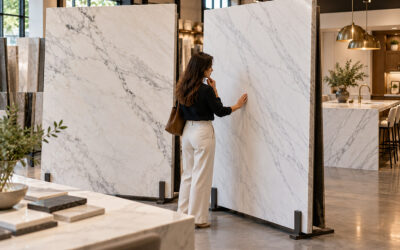
Veining can vary significantly across a single slab, so a small sample does not provide a complete picture. Walk the full slab, look at it from a few angles, and ask whether you can place a hold on a favorite. Before you go, review what to bring to your slab yard appointment, such as cabinet samples and layout drawings.
Ask for a sample to test
If possible, take home an offcut, a leftover piece from a cut slab. Place a few drops of lemon juice and water on it for several minutes, then wipe and look closely. The acid fizz test works the same way: a quick, lively fizz usually points to calcite marble, while a slow, faint fizz suggests dolomite.
Fabrication and templating
After you choose a slab, a fabricator measures your cabinets and creates a template, an exact pattern of your countertop shape. The slab is then cut to size, the edges are shaped into your chosen profile, and seams (where two pieces meet) are placed where they will be least noticeable.
Material availability, pricing, and lead times vary by project and are confirmed in-showroom or by quote.
Conclusion
Dolomite and marble share a family resemblance, but they live a little differently. Dolomite is slightly harder and slower to etch, which makes it a smart pick for busy cooks. Marble offers timeless character and a patina that deepens with use. Both need the same gentle cleaning and regular sealing.
Ready to see these materials in person? The team at Trendy Surfaces has been helping Orange County homeowners, designers, and contractors find the right tile, stone, and flooring for their projects. To walk on full dolomite and marble slabs, start at our Irvine slab yard.
Visit the Irvine Slabyard & Showroom at 17912 Cowan, Unit C, Irvine, CA 92614, or call (714) 284-0118. Or stop by the Laguna Niguel Design Center at 23811 Aliso Creek Road, Ste 176, Laguna Niguel, CA 92677, or call (949) 446-8121.
Frequently Asked Questions
Is dolomite harder than marble?
Yes, slightly. Dolomite rates about 3.5 to 4 on the Mohs hardness scale, while calcite marble rates about 3. That makes dolomite a bit more resistant to everyday scratches, though both are softer than granite and benefit from cutting boards.
Does dolomite etch like marble?
Dolomite can etch, but it reacts more slowly than calcite marble because it contains magnesium. Acids like lemon juice, vinegar, wine, and tomato can still leave dull marks if they sit on the surface. A honed finish helps make any etching less noticeable.
Do dolomite and marble countertops need to be sealed?
Yes, sealing is recommended for both stones to help them resist stains from oils, coffee, and other liquids. Sealer does not prevent etching from acids. Use a water-drop test to check whether it is time to reseal, and follow the sealer’s label for timing.
Which is better for a busy family kitchen, dolomite or marble?
Dolomite is usually the more forgiving choice for a busy family kitchen, since it is slightly harder and slower to etch. Marble can still work well if you enjoy its classic look and are comfortable with patina over time.
How can I tell if a slab is dolomite or marble?
Start by asking your supplier, since trade names are not standardized and composition can vary by quarry. You can also test an offcut with a drop of dilute acid: a quick, lively fizz usually points to calcite marble, while a slow, faint fizz suggests dolomite.