Blog
How Much Do Natural Stone Slabs Cost?

The material is only part of the number, and the other parts are where budgets usually go sideways.
The natural stone slab cost is one of the hardest things to research online, because almost every number you find is either a national average that ignores your project or a single quote that ignores everything else. The truth is that two kitchens with identical square footage can end up thousands of dollars apart, and the reasons are knowable.
This guide breaks down what actually moves the number. This guide doesn’t give you a price, since nobody can do that without seeing your space; instead, it lets you read a quote and understand why it says what it says before you walk into a showroom in Irvine or Laguna Niguel.
Key Takeaways
- Slab price is driven mostly by rarity and origin, not by how beautiful a stone looks in a photo.
- Fabrication labor is a separate and substantial cost, and harder stones take longer to cut and finish.
- Thickness, edge profile, and cutout count each add measurable cost that rarely appears in online averages.
- Buying a stone with widely available lots is one of the most reliable ways to control your budget without compromising on its look.
- Installed cost per square foot is the only number worth comparing between quotes, since material-only pricing hides the majority of the project.
What natural stone slab cost actually includes
An installed natural stone countertop bundles four separate costs: the slab itself, fabrication labor, edge and cutout work, and installation. Published ranges that quote a single number per square foot are almost always describing all four combined, which is why material-only comparisons between suppliers can be so misleading.
Cost guides such as Angi’s natural stone data and HomeAdvisor’s stone installation figures reflect this bundling, and both note wide regional variation.
When you get quotes, ask each one to separate the four components. A supplier with a cheap slab and expensive fabrication can easily end up costing more than the reverse.
The second thing to understand is that slabs are sold whole. If your project needs 42 square feet and the slab is 55, you are buying 55. Remnant use can offset this cost on smaller jobs, but the whole-slab rule governs most kitchens.
Rarity and origin: the biggest single driver
The most significant factor in natural stone slab cost is how rare the material is and how far it traveled. A widely quarried granite from a large, consistently producing deposit costs a fraction of a book-matched marble from a single Italian quarry with limited annual output.
This is why price tiers exist. Suppliers commonly group stone into levels, with entry tiers covering commodity granites and upper tiers covering exotics, semi-precious materials, and highly figured marbles.
Origin adds freight and handling. Material from Italy, Brazil, Turkey, Greece, or India carries shipping costs that shift with fuel prices and container availability, which is part of why stone pricing moves year over year.
Rarity also affects lot availability, which can have budget consequences that people often overlook. If a stone is only ever shipped in bundles of two, a kitchen needing three matched slabs may not be possible, regardless of price.
You are not paying for beauty. You are paying for scarcity, and the two are not the same thing.
How thickness changes the number
Slab thickness is usually 2 cm or 3 cm, and the thicker option typically carries a meaningful premium, both in material and in handling. It is not purely an upcharge, though, because 2 cm often requires a plywood substrate or a laminated edge to look substantial, and those add labor.
Three-centimeter slabs can generally be installed directly on cabinets with no substrate, and they support a wider range of edge profiles without buildup.
Two centimeters is common for vertical applications, wall cladding, and shower walls, where weight matters and edge thickness does not.
If a quote seems unusually low, verify the thickness. Finishing is one of the most common reasons two quotes for the same stone differ.
Finish, hardness, and fabrication labor
Fabrication is charged for labor, and labor scales with how hard the stone is to cut. Dense materials like quartzite wear down tooling more quickly and require more time on the saw and polisher compared to softer stones, resulting in higher fabrication costs for the same layout in harder materials.
Finish plays into the price too. Polished is the standard for most stones and often the baseline price. Honed, leathered, and brushed finishes involve additional processing and commonly carry an upcharge.
The finish decision is worth making on performance grounds as well as cost. Honed surfaces hide etching and fingerprints better on dark stones, while polished surfaces resist staining slightly better because the surface is tighter.
If you are comparing a quartzite slab against a softer marble at a similar material price, expect the fabrication line to differ. That gap is real work, not markup.
Edges, cutouts, and the details that add up
Edge profiles and cutouts are priced individually, and a kitchen can easily accumulate a dozen of them. A simple eased or pencil edge is typically included or close to it, while ogee, waterfall, mitered, and built-up profiles are charged by the linear foot.
Cutouts include the sink, the cooktop, faucet holes, soap dispensers, and any air switch or outlet. Undermount sink cutouts cost more than drop-in because the exposed edge has to be polished.
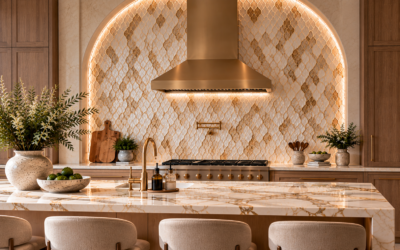
Waterfall Island ends are among the biggest single adders. The mitered corner requires precision, extra material, and, in a veined stone, careful vein matching so the pattern continues around the corner.
Full-height backsplashes are another. They look spectacular and consume slab area that would otherwise go unused, sometimes pushing a project from two slabs to three.
The island waterfall is usually the most expensive twelve inches in the kitchen.
Installation variables that shift the quote
Installation cost depends on access, tear-out, and site conditions more than on square footage. A second-floor condo with a narrow stairwell, an existing tile counter that must be demolished, or cabinets that need shimming all add hours before the stone is even set.
Removal and disposal of an existing countertop is a common separate line item.
Stone quotes usually exclude plumbing and electrical disconnection and reconnection. Budget for a plumber on install day.
Seam count matters too. Fewer seams mean larger, heavier pieces, which sometimes means more installers or specialized lifting equipment.
Where you can control the budget without compromising
The most effective budget lever is choosing a beautiful stone from a widely available category rather than a scarce one. The second is simplifying the edge profile. The third is designing the layout to minimize slab count. None of those three require you to settle for a material you don’t love.
Layout is genuinely powerful. A designer who understands slab dimensions can often reconfigure an island or a run to fit within two slabs instead of three, which saves more than any negotiation would.
Porcelain slabs are worth a look for anyone whose heart is set on a marble aesthetic but whose budget or maintenance tolerance is not. Modern porcelain slabs reproduce dramatic veining with high fidelity and offer very different performance characteristics.
Remnants deserve a mention for smaller projects. Bathroom vanities, fireplace hearths, and laundry counters can often be cut from remnant material at a substantially lower cost.
Material availability, pricing, and lead times vary by project, by lot, and by the fabrication involved, so exact figures are confirmed in the showroom or by written quote rather than estimated online.
Reading a stone quote with confidence
Natural stone slab cost is a stack of decisions, not a single price. Once you can see the stack, quotes stop being intimidating and start being comparable. Ask for the four components separated, confirm the thickness, count your cutouts, and compare installed cost per square foot rather than material alone.
Ready to see these materials in person? The team at Trendy Surfaces has been helping Orange County homeowners, designers, and contractors find the right tile, stone, and flooring for their projects, across everything from commodity granites to onyx and rare exotics.
Visit the Irvine Slabyard & Showroom at 17912 Cowan, Unit C, Irvine, CA 92614, or call (714) 284-0118. Or stop by the Laguna Niguel Design Center at 23811 Aliso Creek Road, Ste 176, Laguna Niguel, CA 92677, or call (949) 446-8121.
Frequently Asked Questions
Why do two quotes for the same stone differ so much?
Usually, the differences are due to thickness, fabrication scope, or edge and cutout pricing. One quote may assume 2 cm with a laminated edge, while the other assumes 3 cm, or one may include tear-out and disposal, while the other does not. Could you please ask both to itemize material, fabrication, edges and cutouts, and installation separately?
Is marble always more expensive than granite?
No. Pricing is driven by rarity rather than by stone type. A common marble can cost less than an exotic granite, while a highly figured statuario can cost several times either of those. Both categories span an expansive range depending on the quarry and the lot.
Do I pay for the whole slab or only what I use?
Slabs are generally sold whole. If your layout needs 40 square feet from a 55-square-foot slab, you buy the slab. Some suppliers offer remnant pricing for smaller projects, which is why bathroom vanities and hearths can often be done more economically.
Does a waterfall island cost much more?
Yes, noticeably. A waterfall end requires additional material, a precise mitered corner, and in veined stone, careful vein matching so the pattern continues down the side. It is one of the highest-cost details in a typical kitchen relative to the surface area it covers.
Can I lower the cost by choosing a thinner slab?
Sometimes, but not always. Two-centimeter material costs less per slab but often needs a plywood substrate or a laminated edge to look right on a countertop, and that labor can absorb the savings. Discuss both options with your fabricator before deciding.