Blog
Porcelain Pavers vs. Natural Stone: Which Holds Up Outdoors?

Both look stunning on day one. Here is how each actually performs after a few Orange County summers.
Choosing between porcelain and natural stone pavers usually comes down to more than looks, since both can create a beautiful patio or pool deck. The real differences show up months and years later, in how each material handles sun, foot traffic, and upkeep. At the Trendy Surfaces showrooms in Irvine and Laguna Niguel, this comparison comes up constantly for homeowners planning an outdoor kitchen, pool deck, or backyard remodel.
Key Takeaways
- Porcelain pavers are nonporous and have a much lower water absorption rate than natural stone, so they resist staining without regular sealing.
- Natural stone offers one-of-a-kind veining and color variation that porcelain replicates but cannot fully duplicate.
- Outdoor-rated porcelain pavers can meet a DCOF of 0.60 or higher for wet-surface slip resistance, with textured finishes built into the tile.
- Natural stone requires periodic sealing and more maintenance over time, while porcelain generally does not need sealing at all.
- Porcelain typically installs faster and costs less upfront than natural stone, which involves quarrying and more labor-intensive installation.
Porcelain vs. Natural Stone Pavers: The Quick Answer
Porcelain pavers are manufactured, nonporous, and built for low maintenance: they resist stains, fading, and moisture without sealing, and they generally cost less to install. Natural stone pavers offer authentic texture and one-of-a-kind color variation, but they are porous, require periodic sealing, and typically cost more in both material and labor.
Neither is the wrong answer. Porcelain tends to win on convenience and budget, while natural stone wins on natural character and long-term visual depth for homeowners willing to maintain it.
Durability and Water Resistance: How Each Handles Outdoor Life
Porcelain pavers absorb less than 0.5% water by weight, compared to natural stone and concrete, which can absorb between 3% and 10%. That low porosity is what makes porcelain resistant to staining, efflorescence, and the kind of moisture damage that shows up on a patio over time.
Natural stone is more porous by nature, which gives it its texture and character but also makes it more prone to absorbing spills, tannins from patio furniture, or minerals from irrigation water if it is not sealed regularly. Neither material is fragile, but porcelain requires far less intervention to stay looking clean.
Porcelain resists stains because water barely gets in. Stone needs sealing to do the same job.
Heat, UV, and Pool Deck Comfort
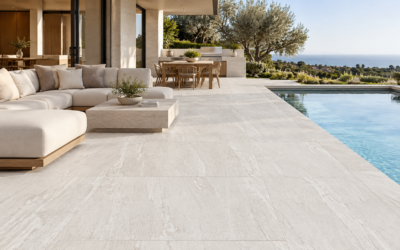
Porcelain pavers hold their color well because the pigment is fired into the material at high temperature, and lighter porcelain shades can stay noticeably cooler underfoot than dark asphalt or concrete, which matters around a pool deck in the Orange County sun. Natural stone also handles heat well structurally, though lighter stones like travertine and limestone are generally more comfortable barefoot than darker granite in direct sun.
For any pool deck or exposed patio, choosing a lighter color in either material will make a real difference on a hot afternoon, more so than the choice between porcelain and stone itself.
Slip Resistance: What to Look for in an Outdoor Paver
Outdoor-rated porcelain pavers can have a dynamic coefficient of friction (DCOF) of 0.60 or higher, which meets ANSI wet-surface slip resistance guidelines, and textured finishes like bush-hammered or structured surfaces add grip directly to the tile. Natural stone can achieve similar slip resistance with a honed, flamed, or naturally textured finish, but smoother polished finishes should be avoided around pools and patios.
Whichever material you choose, ask specifically about the finish and slip rating for wet, barefoot areas like pool decks and outdoor living spaces rather than assuming any paver in the collection is safe for that use.
Maintenance: Sealing, Cleaning, and Long-Term Upkeep
Porcelain pavers generally do not require sealing at all, and routine care is limited to occasional sweeping and hosing down. Natural stone needs periodic resealing, typically every one to three years depending on the stone and exposure, along with more attentive cleaning to avoid staining before it is sealed.
Over a decade of ownership, that maintenance gap is often the deciding factor for homeowners who want a beautiful patio without an ongoing sealing schedule.
Cost and Installation Timelines
Porcelain pavers are generally more economical than natural stone, both in material cost and labor, since porcelain installs faster and does not require the quarrying and cutting that natural stone does. Natural stone typically costs more upfront due to material sourcing and a longer, more labor-intensive installation process, though many homeowners feel the one-of-a-kind look is worth the difference.
Exact pricing depends heavily on the specific stone or porcelain line, paver size, and the scope of the installation, so an in-showroom quote is the most reliable way to budget either option.
Design Considerations: Matching Pavers to Your Home’s Style
Today’s porcelain paver collections replicate the look of travertine, slate, and other natural stones closely enough that many homeowners choose porcelain purely for its performance without giving up the aesthetic they wanted. Natural stone still has an edge for homeowners who want the subtle color and vein variation that only a quarried material can offer, since no two pieces are exactly alike.
For more layout and application ideas, see our related post on outdoor tile and paver ideas for patios, pools, and backyards.
Ready to compare porcelain and natural stone pavers in person? The team at Trendy Surfaces has been helping Orange County homeowners, designers, and contractors find the right tile, stone, and flooring for their projects.
Visit the Irvine Slabyard & Showroom at 17912 Cowan, Unit C, Irvine, CA 92614, or call (714) 284-0118. Or stop by the Laguna Niguel Design Center at 23811 Aliso Creek Road, Ste. 176, Laguna Niguel, CA 92677, or call (949) 446-8121. Material availability, pricing, and lead times vary by project and are confirmed in the showroom or by quote.
FAQ
Are porcelain pavers better than natural stone for a patio?
It depends on priorities. Porcelain generally requires less maintenance, resists stains better, and costs less to install, while natural stone offers unique veining and texture that many homeowners prefer, at the cost of more upkeep.
Do natural stone pavers need to be sealed?
Yes, most natural stone pavers benefit from periodic sealing, typically every one to three years, to resist staining and reduce water absorption. Porcelain pavers generally do not need sealing.
Which paver is safer around a pool?
Both porcelain and natural stone can be manufactured or finished with good slip resistance. Look for a textured finish and, for porcelain, a DCOF of 0.60 or higher, which meets wet-surface slip resistance guidelines.
Do porcelain pavers get hot in the sun?
Porcelain can heat up in direct sun like any hard surface, but lighter colors stay noticeably cooler than dark asphalt or concrete, and the color is fired in, so it will not fade like some other materials can over time.
Are porcelain pavers cheaper than natural stone?
Generally, yes. Porcelain typically costs less in both material and installation, since it does not require the quarrying and longer installation process that natural stone does, though exact pricing depends on the specific product and project scope.